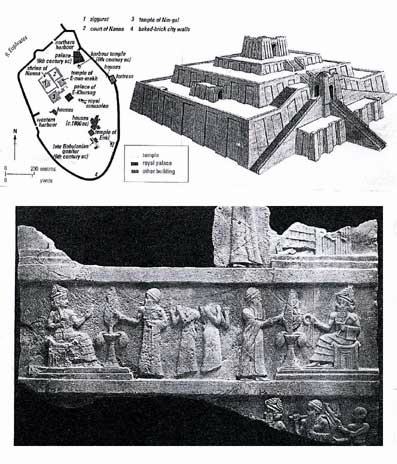
A SUMERIAN CAPITALLike many Mesopotamian cities of its day, the center or Ur (see plan below) was dominated by a sacred enclosure containing temples and related buildings; the most famous of these was the three-storeyed ziggurat, the lowest storey alone standing some 15 metres high. Clay tablets found within the sacred enclosure were given in receipt for goods – butter, oil and gold – suggesting that offerings were brought here. Food for the god was prepared in a kitchen within the precinct; inscribed copper cylinders speak of thee ‘evening and morning meals’ to the god. To the south of the sacred enclosure lay the burial area of the kings of Ur. Still further south an area of private houses of c. 1800 BC has been exposed, probably typical of those to be found throughout the whole city, crossed by a network of unpaved streets, too narrow for wheeled vehicles. Like most buildings at Ur, the houses were built largely of mud-brick, though baked-brick was used for foundations and the street frontage. The lower storey was devoted to the kitchen, guest room, store-rooms and servants’ quarters, arranged around an open court, while the living rooms were on the first floor. Clay tablets identify one of the houses as that of Igmil-Sin, headmaster of a boys’school. Another house belonged to Ea-nasir, a merchant in the copper trade. Right. aerial
view of ziggurat and sacred enclosure at Ur.
STELA OF
UR-NAMMU
|