JUPITER OF BAALBEK AND DAMASCUS
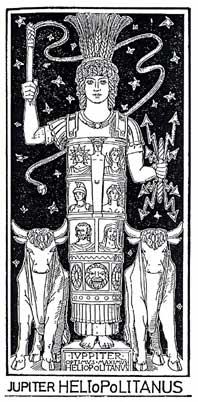
Baalshamain, otherwise known as Hadad, or Baal-Hadad, or Baaal was the ancient Sun God of the Semites long before the days of Yahweh, or Jehovah. He was worshipped in various parts of the Middle East under the aliases of Bel, and Bol. Beside being a Sun God, he became the god of the Sky, Land and Sea, of Rain, Lightning and Thunder, of Fertility and Fecundity, and finally creator god of the Univers, and avowed God of gods. It was at his altars that pilgrims sacrificed, and it was his help that they beseeched, because when in good humour he sent rain down to bless the crops, but when in ill humour he sent floods to destroy crops and flocks. He is depicted here displaying all his ranks and attributes. On the head, a calathos made of ears of wheat (fertility); heavy hair in tresses (strength and longevity); heavy set neck (virility) around which he wears the solar disk (solar divinity); the whip in the right hand alludes to the course of the sun in the sky; the thunderbolt and lightning in the left hand (rain and floods); the two young bulls on his flanks are the traditional symbols of power and fecundity. His cassock is incrusted with the seven deities he has assimilated and over whom he dominated: at the bottom, flanked by two suns, the lion’s head symbolizes the Sun of Arabia; just above, the venerable old couple are Zeus and Hera; above them we see Athena wearing a casque and Venus wearing nothing. On the top row we recognize Luna with the large crescent moon and Helios with the sun burst. The central figure whose bust stands on a stele in none other than Hermes the messenger of the gods. The inscription on the pedestal reads: JUPITER OPTIMUS MAXIMUS HELIOPOLITANUS. This leaves no doubt about his being a solar (helio) god (heliopolitanus) of the highest rank (optimus maximus). I.O.M.H. which is the abbreviation of this pretentious title name is to be seen in many places while exploring the Temple complex. FINALLY, THE GOD OF ALL GODS Early during th e Greek domination of the Middle East, Helios was identified with Baal-Hadad as both were already recognized sun gods. Later, before the end of Hellenistic era (330-146 B.C.), Zeus was supplanted by Jupiter. And, since both Jupiter and Baal personified a number of similar forces and attributes (rain, thunder, lightning, fertility, fecundity, etc….) they were equated, fused and merged under the appellation of Jupiter Heliopolitanus, meaning: the sun father god. From Baalbek – A Story in Stone by Michael Harriz |