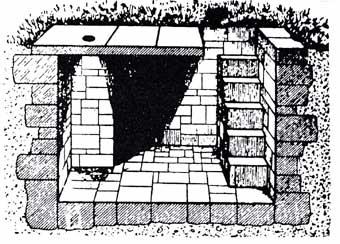
STONE BLOCKSThe huge blocks of stone at Tiahuanaco were held together by copper, and sometimes by gold rivets, a method of building-constructions found also in Assyria and Etruria. Some blocks of stone used at Tiahuanaco weighed a hundred and others even two hundred tons. They were brought from Kiappa, a distance of forty miles as the crow flies. Solid stone wheels have been found which could have been used to move them. The Sumerians themselves are the first people of whom we have evidence who used a solid wheel. The blocks were probably sawn out of the rock face by a method used by the Cretans, who sawed rock into ashlars with bronze saws. The use of cyclopean stone blocks has passed out of fashion in the Mediterranean by 1500 B.C. There are other similarities to New World and Old World architecture. Thus, there little round holes in the top slabs of graves at Tiahuanaco, precisely as in Egyptian tombs, to let through the soul, presumed as being essential by the burial ritual of the Egyptians.
There are double parallel walls at Tiahuanaco, with large stones outside and the center filled with soil, a method of building used in Crete and indeed all over the Middle East. The reed boats plying on Lake Titicaca, and on the eastern coast of Brazil, both in construction and material, resemble the Egyptian papyrus boats. The Aztec name of temples was teocallis, for their ancient city of priests was Teotihuacan, for this center of culture in Peru, ruled by priest-kings, the name was Tiahuanaco. The Mykenaean word for god is teo and in Greek Cretan Linear B, wanak means ‘king’ At Tiahunanaco there were swastika designs, found engraved on the building stone, as in the Indus valley. It was also used on Tiahunaco ceramics. In Utah, obsidian discs or ‘coins’ have been dug up identical with discs found in the valley of the Nile near the Egyptian pyramids. Mrs Verrill maintains that the symbols on these Utah coins are: ‘Of the type found in Hittite glyphs and in the archaic, so-called Sumerian script. This script was employed by the earliest dynasties of Egypt and also in the pre-dynastic period.’ She elsewhere maintains: At Lake Tizcoco, at depth of fifteen feet below the surface of the mud, a ceremonial stone mace head was dug up and is now in the Chicago Natural History Museum. This is unique and unlike any other caved stone object ever found in America but is almost identical in shape with stone mace heads found in the Near East known to have belonged to Naram-Sin and his grandfather, King Sargon of Agade, and with existing portraits of identical features and helmet or headdress. Anyone comparing the Mexican specimen with those shown (the Old World heads) will instantly see the striking similarity between the Mexican portrait mace head and Near Eastern portraits in bas-relief that are known to represent Naram-Sin. The beard and features are the same. The helmets with the chin covers are identical, even to the links under the chin, as are the segmented or quilted top of the helmet and the twisted rope like decoration encircling the lower edge. It is utterly inconceivable and beyond reason to believe that any ancient Aztec, Toltec or other Mexican artisan could have conceived such a human being as is so obviously accurately carved on the mace head. Even admitting the bearded men were common and frequently are depicted in sculptures and paintings of the ancient Mexicans, the beards were never of the type shown on the mace head. Even more convincing is the remarkable stone pendant found in August, 1936, in Gallo Canyon, near an ancient Pueblo ruin in New Mexico, by Dr. Charles F. Elvers. The pendant or amulet is of very hard dark gray stone of pear shape, about three inches in length, with a perforation at the upper or narrow end and has incised carvings on both sides. On one side there is the figure of a man holding a crooked or serpent-like staff in his right hand and apparently climbing up a slope while looking over his right shoulder. There is a crown on his head but no garments are indicated. On the other side of the pendant is an inscription composed of an elephant head, a triangle, a cross, a circle and two six-pointed stars. These are all symbols of glyphs used in the archaic Sumerian Linear Script….. From The God-Kings & The Titans by James Bailey
|